Pench National Park is one of central India’s best-known tiger landscapes, spread across the southern Satpura region of Madhya Pradesh close to the Maharashtra border. Teak-dominated forest, open woodland, grasslands, seasonal streams and the Pench reservoir create varied habitat for tigers, leopards, wild dogs, gaur and large herds of deer. The relatively open character of parts of the reserve can make wildlife viewing especially rewarding.
The Madhya Pradesh national park covers 292.857 sq km and is officially known as Indira Priyadarshini Pench National Park. Together with Pench Mowgli Sanctuary and adjoining forest, it forms the core of Pench Tiger Reserve. The entire Madhya Pradesh tiger reserve, including its buffer, covers about 1,179.63 sq km and extends across Seoni and Chhindwara districts.
Pench also has a strong literary association with the Seoni landscape made famous by Rudyard Kipling’s Jungle Book stories. The modern national park should not be treated as the literal setting of every Jungle Book episode, but the forests, wildlife and older natural-history writing from the Seoni region helped create the cultural connection that still draws visitors today.
| Particulars | Details |
| Destination | Pench National Park / Pench Tiger Reserve, Madhya Pradesh |
| Where it is located | Seoni and Chhindwara districts, Madhya Pradesh, near the Maharashtra border |
| National Park area | 292.857 sq km |
| Core area of Pench Tiger Reserve | 411.330 sq km |
| Total MP Tiger Reserve area | About 1,179.63 sq km including buffer |
| National Park status | 1983; final notification in 2005 |
| Main core gates | Turia, Karmajhiri and Gumtara/Jamtara side access, subject to current booking system |
| Important buffer gates | Teliya, Rukhad and Khawasa; other buffer routes may operate |
| Tourism season | 1 October to 30 June |
| Monsoon closure | July to September for regular core tourism |
| Safari shifts | Morning and afternoon; timings vary by month |
| Indicative MP permit | About ₹1,500-₹3,100 per vehicle depending on zone/date category |
| Gypsy hire | Around ₹3,500 per safari |
| Guide charge | Around ₹800-₹1,000 |
| Best known for | Tigers, leopards, wild dogs, teak forest and Pench landscape |
| Recommended stay | 1-2 nights with at least two safaris |
| Best season | November to February for comfort; March-May for hotter wildlife viewing |
Pench National Park Safari Timings
Pench operates morning and afternoon safaris, with entry and exit times changing through the season according to daylight. The official Pench Tiger Reserve schedule lists October morning entry at 6:00 AM and afternoon entry at 3:00 PM. By December, morning entry moves to 6:30 AM and the evening exit becomes earlier.
In January, morning entry is listed at 6:45 AM. From February onward the morning shift gradually begins earlier, reaching 5:30 AM in May and June. Afternoon entry is generally 3:00 PM from October to March and 4:00 PM from April to June.
Morning safaris normally finish by 11:00 AM. The reserve remains closed for the afternoon safari every Wednesday. Regular tourism operates from 1 October to 30 June, while July, August and September are closed for core tourism during the monsoon. Park management can change these timings for operational or wildlife-management reasons.
Month-wise Safari Timings
| Month | Morning / Afternoon |
| October | 6:00 AM-11:00 AM / 3:00 PM-6:00 PM |
| November | 6:15 AM-11:00 AM / 3:00 PM-5:45 PM |
| December | 6:30 AM-11:00 AM / 3:00 PM-5:30 PM |
| January | 6:45 AM-11:00 AM / 3:00 PM-5:45 PM |
| February | 6:30 AM-11:00 AM / 3:00 PM-6:15 PM |
| March | 6:15 AM-11:00 AM / 3:00 PM-6:30 PM |
| April | 5:45 AM-11:00 AM / 4:00 PM-6:45 PM |
| May | 5:30 AM-11:00 AM / 4:00 PM-7:00 PM |
| June | 5:30 AM-11:00 AM / 4:00 PM-7:00 PM |
Pench National Park Safari Cost
Pench safari pricing on the Madhya Pradesh side is best understood as several separate components rather than one fixed all-inclusive ticket. The MP Forest Department’s online system issues the entry permit, while the registered safari vehicle and guide are charged separately at or through the park system.
Madhya Pradesh Tourism’s current planning information places the vehicle permit at roughly ₹1,500 to ₹3,100 for domestic visitors depending on whether the booking is for a core or buffer zone and whether the selected date falls under a premium category. A registered Gypsy is approximately ₹3,500 for a safari, while the guide is generally around ₹800-₹1,000.
This means a practical full-vehicle safari on the Madhya Pradesh side can often work out to roughly ₹5,800-₹7,600 before any portal fees or later tariff revisions. This is a planning estimate, not a guaranteed checkout price.
| Safari Component | Indicative 2026 Planning Cost |
| MP Forest vehicle permit | Around ₹1,500-₹3,100 depending on core/buffer and date category |
| Registered Gypsy | Around ₹3,500 per safari |
| Guide | Around ₹800-₹1,000 |
| Typical combined planning range | Roughly ₹5,800-₹7,600 per vehicle before portal/other applicable charges |
The official MPOnline booking portal currently states that vehicle and guide charges are not included in the online permit amount and must be paid separately. It also warns that tariff changes may require visitors to pay a difference at the park counter.
For that reason, travellers should use the final amount displayed by the official Madhya Pradesh Forest Department booking system for their chosen date rather than relying on a fixed rate copied from an older article or travel agency.
Safari Gates and Zones
Turia is the best-known gateway to the Madhya Pradesh side of Pench and has the largest concentration of lodges and registered safari vehicles. It is approached from Khawasa on NH-44 and is especially convenient for travellers coming from Nagpur.
Karmajhiri provides another core entry from the eastern side and offers a quieter base with fewer accommodation options. The official reserve also lists core tourism capacity through Gumtara, while older material often refers to Jamtara as an important Chhindwara-side entry point. Visitors should follow the gate names and availability shown on the live MPOnline booking page for the selected season.
Important buffer tourism gates include Teliya, Rukhad and Khawasa. Buffer safaris can be worthwhile when core permits are unavailable and should not automatically be considered inferior; tigers, leopards, wild dogs and other animals move across the larger reserve landscape.
Wildlife Safari Experience
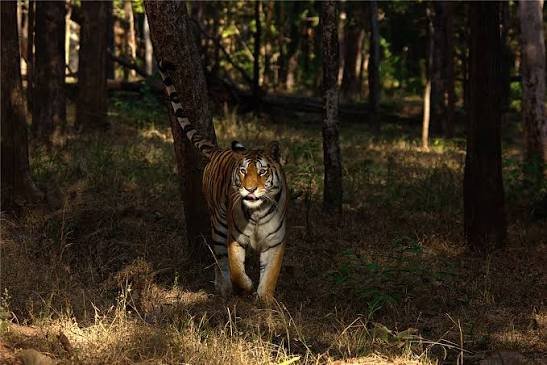
Pench is particularly well known for Bengal tigers, but the reserve supports a much wider predator community. Leopards, dholes or Indian wild dogs, striped hyenas, jackals and jungle cats occur in the landscape.
Chital are among the most commonly seen herbivores and may appear in large groups. Sambar, gaur, nilgai, wild boar and four-horned antelope are also present. Open meadows and water sources can become productive wildlife-viewing areas, particularly during the dry months.
No tiger sighting is guaranteed. The best safari is often one that pays attention to alarm calls, tracks, langur behaviour, birds and other signs of the forest instead of judging the entire drive only by whether a tiger appears.
Pench Reservoir and Forest Landscape
The Pench River and reservoir are important features of the reserve. Construction of the Pench hydroelectric dam submerged a substantial area of the original landscape and created a large water body straddling the Madhya Pradesh-Maharashtra region.
The surrounding forest is dominated in many places by teak, with mixed woodland, bamboo, grassland and riverine habitat adding variety. Seasonal changes are dramatic: the post-monsoon forest is green and dense, winter is cool and dry, and late summer leaves much of the landscape open and dusty.
This variety helps explain why Pench supports both large carnivores and a rich prey base.
The Jungle Book Connection
Pench is widely promoted as part of India’s Jungle Book country because Rudyard Kipling placed Mowgli’s world in the broader Seoni or ‘Seeonee’ region of central India. Older natural-history writing about Seoni and the Satpura forests contributed descriptions of local wildlife and landscapes that became associated with the stories.
Visitors should understand this as a regional literary connection rather than as proof that a particular safari trail or modern park gate was the exact location of Mowgli’s adventures. Even so, the dry forest, ravines, wolves, big cats and village-forest setting make the association easy to appreciate.
How to Reach Pench National Park
The easiest access depends on the booked gate. For most first-time visitors using Turia, Nagpur is the most convenient major transport hub.
By Air
Nagpur’s Dr. Babasaheb Ambedkar International Airport is roughly 85-90 km from Turia and is the most practical airport for the main tourism cluster. Jabalpur is another option but is considerably farther from Turia.
By Train
Nagpur is the most useful major railway station for Turia and has excellent long-distance rail connections. Seoni and Chhindwara can be useful for other sides of the reserve depending on the gate and current train services.
By Road
Turia is about 85 km from Nagpur via Khawasa. The official reserve information places Karmajhiri at about 135 km from Nagpur and roughly 50 km from Seoni. Travellers should navigate to the exact booked safari gate because the entrances are far apart and cannot be treated as interchangeable.
Best Time to Visit Pench National Park
November to February is the easiest period for general travellers. Early mornings can be cold, but daytime conditions are pleasant and the forest is comfortable for long jeep safaris.
March to May is hotter, yet serious wildlife enthusiasts often favour the dry season because vegetation becomes thinner and animals concentrate more around remaining water sources. May can be extremely hot, so suitable clothing, water and sun protection are important.
October is attractive immediately after the monsoon, with greener forest and fuller water bodies. Core tourism closes during July, August and September.
How Much Time Is Needed?
A single safari gives only a brief introduction to Pench. Wildlife-focused travellers should ideally stay for one or two nights and take at least two safari drives, preferably at different times of day.
Two or three safaris improve the chance of seeing different habitats and wildlife behaviour. Visitors staying near Turia can also consider a buffer safari when core permits are unavailable.
Because Nagpur is relatively close, Pench is easier to combine with a wider central India itinerary than many more remote tiger reserves.
FAQs
Q. Is Pench National Park in Madhya Pradesh or Maharashtra?
Pench extends across the Madhya Pradesh-Maharashtra landscape, and both states have protected areas and safari operations carrying the Pench name. This guide focuses on the Madhya Pradesh side.
Q. Which gate is best for a first Pench safari?
Turia is usually the most convenient first choice because it has the largest tourism infrastructure, many registered safari vehicles and easy road access from Nagpur.
Q. Is a tiger sighting guaranteed in Pench?
No. Pench is an important tiger reserve, but tigers are wild animals and sightings depend on movement, habitat, weather and chance.
Q. Are buffer safaris worth booking?
Yes. Buffer forests form part of the wider tiger landscape and can produce excellent sightings of tigers, leopards, wild dogs and herbivores. They are also useful when core permits are sold out.
Q. Why does the safari price vary by date?
Madhya Pradesh uses different permit categories, including premium and non-premium dates, while core and buffer permits can also differ. Vehicle and guide charges are additional to the online permit.
Q. Is Pench really connected with The Jungle Book?
The association comes from the wider Seoni landscape and old natural-history accounts that influenced the setting of Kipling’s stories. The modern national park should not be treated as the exact site of every fictional event.
Q. Does Pench close every Wednesday?
The park is not closed for the whole day every Wednesday. The official Pench schedule states that the afternoon safari is closed on Wednesdays; morning tourism continues subject to current forest orders.