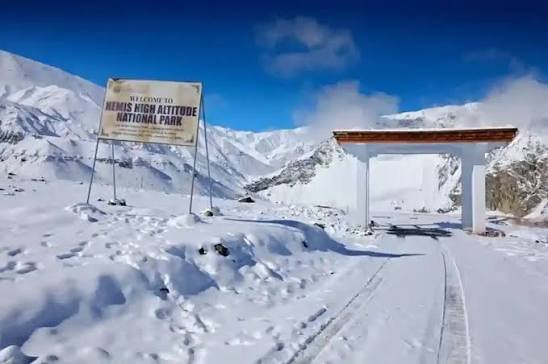
Hemis National Park is one of India’s most extraordinary protected landscapes, stretching across the cold, high-altitude desert of Ladakh south of Leh. Unlike the forested tiger reserves of central and southern India, Hemis is a world of barren ridges, deep valleys, alpine slopes and fast-flowing mountain streams. It is best known as one of the finest places on Earth to look for the elusive snow leopard in the wild.
Established in 1981, Hemis is described by current Government of India tourism sources as covering about 4,400 sq km, making it the largest national park in India. The park protects a representative Trans-Himalayan ecosystem and supports snow leopards, bharal or blue sheep, Ladakhi urial, Asiatic ibex, Tibetan wolf, Eurasian brown bear, red fox, Himalayan marmot and several high-altitude birds. The landscape also includes traditional villages and trekking routes that have been used by local communities for generations.
There is no regular Forest Department jeep or Canter safari network. Much of the meaningful wildlife experience is on foot, often with a trained local guide or spotter. Summer visitors come mainly for trekking, scenery and birdlife, while winter travellers visit Rumbak and nearby valleys specifically for snow-leopard tracking.
| Particulars | Details |
| Destination | Hemis National Park |
| Where it is located | Leh district, Ladakh, south and south-east of Leh |
| Area | About 4,400 sq km |
| Established | 1981 |
| Nearest major city | Leh |
| Distance from Leh | Roughly 40-50 km to the Hemis/park approach area, depending on route |
| Published visitor timings | 9:00 AM to 5:00 PM |
| Latest widely published entry fee | Indian visitor ₹20; foreign visitor ₹100 |
| Regular jeep/Canter safari | Not available |
| Main wildlife experience | Trekking and guided wildlife/snow-leopard tracking |
| Best time for trekking | May to September |
| Best time for snow leopards | December to March |
| Recommended stay | 1 day for a basic visit; 4-7 days for serious wildlife tracking |
Hemis National Park Timings
The Government of India’s Incredible India portal currently lists Hemis National Park visitor hours as 9:00 AM to 5:00 PM. These timings are useful for a general sightseeing plan, but Hemis is not a gated safari park where every visitor follows one fixed circuit. Trekking routes, village stays and winter wildlife expeditions operate according to daylight, weather, local permissions and the itinerary arranged with guides or homestays.
The park is generally described as accessible through the year, but conditions change dramatically by season. Snow can make high passes and trails difficult or inaccessible in winter, while summer is the main trekking period. Anyone planning a long trek should follow route-specific advice rather than relying only on the general 9:00 AM to 5:00 PM visitor timing.
Hemis National Park Ticket Cost
Hemis has a very modest basic wildlife-entry fee compared with many Indian national parks. The latest widely published visitor tariff lists ₹20 per person for Indian nationals and ₹100 per person for foreign visitors. A dedicated 2026 Wildlife Department tariff sheet is not currently published prominently online, so these amounts are best treated as planning figures and should be confirmed at the relevant check post or Wildlife Department office in Leh before a trek.
| Visitor Category | Latest Published Entry Fee |
| Indian visitor | ₹20 per person |
| Foreign visitor | ₹100 per person |
The entry fee should not be confused with the cost of a snow-leopard expedition. Serious winter wildlife trips require local guides or spotters, transport to the trailhead, homestays or camps, food and often several days of tracking. These are private or community-based services rather than a standard park safari ticket, so prices vary widely according to duration and comfort level.
Foreign visitors should also check the current Protected Area Permit and Restricted Area Permit rules for their exact Ladakh itinerary. The Ladakh administration was reviewing this permit framework in August 2026, and requirements can depend on nationality and the specific restricted area being visited.
Why Hemis Has No Regular Jeep Safari
Much of Hemis is rugged, roadless mountain country. Tourist vehicles cannot simply drive through the park searching for wildlife in the way they do on the forest tracks of tiger reserves. Entry points and trekking corridors such as Zingchen, Rumbak, Skiu and Shang Sumdo lead into valleys where walking is the primary mode of exploration.
This makes Hemis slower and more demanding, but also more intimate. Wildlife is usually located by scanning ridgelines and slopes with binoculars or spotting scopes, checking animal tracks and listening to information shared by local residents and guides. A snow leopard may be several hundred metres away on a rocky mountainside rather than beside a vehicle track.
Snow Leopard Experience at Hemis
The snow leopard is the main reason Hemis has an international reputation. Winter, particularly from December to March, offers the best chance because snow leopards and their prey descend towards lower valleys. Rumbak Valley is one of the best-known bases for these expeditions.
Snow-leopard watching is not a quick two-hour activity. Travellers may spend several days scanning slopes before obtaining a sighting. Cold, wind and altitude make the experience physically demanding, and winter temperatures can fall far below freezing. Even so, no sighting can be guaranteed because the animals are completely wild.
Bharal, or blue sheep, are especially important because they are a principal prey species for snow leopards. Ladakhi urial, Asiatic ibex, red fox and Tibetan wolf may also be encountered depending on the valley and season.
Trekking in Hemis National Park
Summer transforms Hemis into one of Ladakh’s major trekking landscapes. The Markha Valley route is the most famous and passes through high-altitude villages, river valleys, pasture areas and mountain passes. Other approaches connect Stok, Zingchen, Rumbak, Yurutse, Skiu and Shang Sumdo.
Trekking here should not be treated like a casual city walk. Many routes remain above 3,500 metres, and high passes approach or exceed 5,000 metres. Travellers need proper acclimatisation in Leh, suitable footwear, warm layers, sun protection and enough time to walk at a slow pace.
Homestays in villages along trekking routes provide a distinctive alternative to large hotels. They also allow tourism income to reach local households living in and around the protected landscape.
Wildlife at Hemis National Park
Hemis protects species specially adapted to the dry, cold Trans-Himalayan environment. Along with snow leopards, the park supports bharal, Ladakhi urial or shapu, Asiatic ibex, Tibetan wolf, Eurasian brown bear, red fox, Himalayan marmot, mountain weasel and Himalayan mouse hare.
Birdwatchers can look for golden eagle, lammergeier or bearded vulture, Himalayan griffon, chukar, Himalayan snowcock, red-billed chough, robin accentor, streaked rosefinch and other high-altitude species. Government tourism information records more than 70 bird species in the park.
Vegetation is sparse compared with a conventional forest national park. Juniper, dry birch, steppe vegetation, alpine grasses and medicinal plants survive in sheltered areas, while huge expanses remain rocky and nearly treeless.
Hemis Monastery and Cultural Landscape
Hemis National Park takes its name from the famous Hemis Monastery, one of Ladakh’s most important Buddhist monasteries. The monastery is around 40-45 km from Leh and is closely associated with the protected landscape. It is particularly famous for the annual Hemis Festival, with masked dances and religious ceremonies.
The wider park is also a lived cultural landscape. Villages and seasonal pastoral activity have existed here for generations, making conservation closely connected with local communities rather than completely separating people from the mountains.
How to Reach Hemis National Park
By Air
Kushok Bakula Rimpochee Airport at Leh is the nearest airport. Leh has air connections with Delhi and several other Indian cities. Because of the altitude, visitors arriving by air should spend at least one or two days acclimatising before strenuous trekking.
By Road
Hemis village is roughly 40-45 km from Leh by road, while access to different trekking routes varies. Zingchen is commonly used for Rumbak and snow-leopard trips, and Shang Sumdo is a gateway for the Markha Valley side. Taxis can take travellers to permitted roadheads, after which much of the journey continues on foot.
By Train
Ladakh has no direct railway connection. Jammu Tawi is among the commonly cited major railheads, but it is a long road journey from Leh. Most short-duration travellers therefore fly to Leh rather than combine rail and road travel.
Best Time to Visit Hemis National Park
There is no single best month because the ideal season depends on the purpose of the trip. From May to September, temperatures are more comfortable, trails are generally clearer and the park is best suited to trekking, landscape photography and birdwatching.
December to March is the specialist wildlife season. Snow and severe cold make travel harder, but this is when snow leopards are more likely to move into lower valleys. January and February are particularly popular with dedicated wildlife photographers and naturalists prepared for sub-zero conditions.
How Much Time Is Needed?
A traveller visiting Hemis Monastery and getting a basic introduction to the nearby landscape can make a day trip from Leh. Hemis National Park itself deserves much more time if trekking or wildlife is the main purpose.
A short Rumbak-area trek may take two or three days, while a serious winter snow-leopard expedition commonly needs four to seven days in or around the tracking area. The Markha Valley Trek is also a multi-day journey and should be planned separately from a quick sightseeing visit.
FAQs
Q. Can tourists see Hemis National Park by jeep like Ranthambore?
No. Hemis does not have a regular jeep or Canter safari system. Much of the park is explored on foot, and wildlife watching normally involves trekking with guides or local spotters.
Q. Is a snow leopard sighting guaranteed in Hemis?
No. Hemis is excellent snow-leopard habitat, but the cats are wild, secretive and range over large mountain areas. Even multi-day expeditions cannot guarantee a sighting.
Q. Is Hemis suitable for first-time high-altitude travellers?
It can be, but visitors must acclimatise properly in Leh before trekking. Anyone with no previous altitude experience should begin with shorter walks rather than immediately attempting a high pass or winter expedition.
Q. Can Hemis be visited in winter?
Yes, and winter is the prime snow-leopard season. However, temperatures are severe, daylight is limited and trails can be icy or snow-covered, so experienced local support is strongly advisable.
Q. Are there hotels inside Hemis National Park?
Large conventional hotels are not the normal accommodation within the trekking landscape. Visitors generally use village homestays, simple camps or stay in Leh and travel to the relevant trailhead.
Q. Is Hemis National Park the same as Hemis Monastery?
No. Hemis Monastery is a major Buddhist monastery associated with the area and gives the park its name, while Hemis National Park is the much larger protected mountain landscape.
Q. Which area is best known for snow-leopard tracking?
Rumbak Valley and nearby valleys such as Husing and Yurutse are among the best-known winter tracking areas because prey animals and snow leopards use these rugged slopes.
Q. Does Hemis have a weekly closing day?
No standard weekly closure is prominently listed for the national park. Access is more likely to be affected by weather, snow, trail conditions or route-specific restrictions than by a fixed weekly holiday.