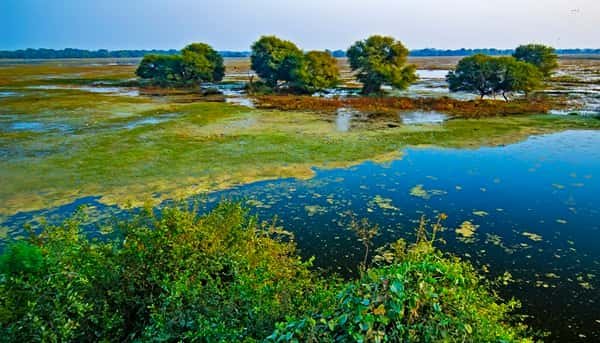
Keoladeo National Park is one of India’s finest birdwatching destinations and an unusual national park where the experience is built around wetlands, walking trails, cycles and cycle-rickshaws rather than a conventional jeep safari. Located at Bharatpur in eastern Rajasthan, the park was formerly known as Bharatpur Bird Sanctuary and Keoladeo Ghana National Park. Its compact 28.73 sq km landscape contains shallow wetlands, grasslands, woodland, marshes and dykes that support a remarkable concentration of resident and migratory birds.
The wetland was historically managed as a royal duck-shooting reserve, but conservation gradually replaced hunting. Keoladeo was designated a Ramsar Site in 1981, declared a national park in 1982 and inscribed as a UNESCO World Heritage Site in 1985. UNESCO records around 375 bird species in this small protected area, while Rajasthan Tourism describes it as one of the world’s important bird breeding and feeding grounds. Painted storks, pelicans, herons, egrets, cormorants, ducks, geese, raptors and many smaller species can be seen according to season and water conditions.
Unlike tiger reserves, Keoladeo does not require visitors to sit inside a safari vehicle. Much of the park can be explored on foot, by bicycle or by cycle-rickshaw, and trained rickshaw pullers are known for their bird-identification skills. The best months for migratory waterfowl are generally November to February, while the monsoon and post-monsoon period can be excellent for nesting heronries and greener scenery.
| Particulars | Details |
| Destination | Keoladeo National Park / Bharatpur Bird Sanctuary |
| Where it is located | Bharatpur, Rajasthan |
| Area | 28.73 sq km / 2,873 hectares |
| Ramsar status | Designated in 1981 |
| UNESCO World Heritage status | Inscribed in 1985 |
| General visiting hours | Around 6:00 AM to 5:00/6:00 PM depending on season |
| Weekly closure | No regular weekly closure; normally open daily |
| Latest widely reported Indian entry | ₹155 per adult; 2026 statewide fee revision means visitors should confirm the current gate rate |
| Latest widely reported foreign entry | ₹959 per person; confirm current post-revision gate rate |
| E-rickshaw / cycle-rickshaw | Commonly hired by time; recent reports show about ₹800 for 2 hours and ₹1,200 for 3 hours |
| Best time to visit | November to February for migratory birds |
| Recommended duration | 3-5 hours; serious birders may spend a full day or return twice |
| Nearest railway station | Bharatpur Junction, about 5 km away |
| Nearest major airport | Agra Airport, about 56 km away |
Keoladeo National Park Timings
Keoladeo is normally open every day from early morning until evening, but the closing time changes with daylight and season. A practical planning range is about 6:00 AM to 6:00 PM in the longer summer months and around 6:30 AM to 5:00 PM in winter. Recent 2026 visitor listings commonly show a 6:00 AM opening and a 5:00 PM closing window.
Early morning is the strongest time for bird activity and photography, especially from November to February. Arriving close to opening also helps visitors cover the main wetland sections before midday. Late afternoon is another productive period, although anyone using a cycle or rickshaw should keep enough time to return to the gate before closing.
Because operating hours can be adjusted for season, water management, weather or administrative reasons, the gate timing on the day of visit should be treated as final.
Keoladeo National Park Ticket Cost
Keoladeo uses a simple entry system, but the total cost depends on how visitors choose to explore the park. Entry, cycle-rickshaw or e-rickshaw hire, bicycle rental and naturalist-guide services are separate components.
The most widely reported recent gate figures are ₹155 for an Indian adult, ₹62 for an Indian student and ₹959 for a foreign visitor. In March 2026, Rajasthan announced a 10% revision in protected-area entry and related charges from April 1, 2026. The state tourism page does not currently display a clear Keoladeo-specific post-revision tariff, and recent 2026 visitor reports still cite the earlier figures. Visitors should therefore confirm the current amount at the official gate rather than relying on an older online tariff.
| Component | Recent Planning Figure |
| Indian adult entry | ₹155 widely reported before/around the 2026 revision; confirm current gate rate |
| Indian student entry | ₹62 widely reported; confirm current rate |
| Foreign visitor entry | ₹959 widely reported; confirm current rate |
| Rickshaw / e-rickshaw | About ₹800 for 2 hours or ₹1,200 for 3 hours in recent reports |
| Trained wildlife guide | About ₹800 for 2 hours or ₹1,200 for 3 hours in recent reports |
For most first-time visitors, a two- to three-hour rickshaw ride gives an efficient introduction because the driver knows the main birding points and can cover more ground than a casual walk. Serious birdwatchers often combine cycling or walking with a trained naturalist and spend much longer inside.
How to Explore Keoladeo National Park
Walking
Walking is the simplest and quietest option. The main road through the park is level and suitable for visitors who enjoy a long, slow birding session. The drawback is distance: the most productive wetland areas are not all close to the entrance, so a full walking visit can become tiring.
Bicycle
Bicycles are a popular option because they allow visitors to move independently while remaining quiet enough for birdwatching. Rental cycles are generally available near the entrance, although availability and rates can vary. A bicycle works best for travellers who are comfortable stopping frequently and identifying birds on their own.
Cycle-rickshaw or E-rickshaw
Rickshaws are one of Keoladeo’s signature experiences. Many drivers have received birdwatching training and can point out species that first-time visitors would otherwise miss. They also know where colonies, roosts and frequently used feeding areas are located. This makes a rickshaw particularly useful for families, elderly visitors and travellers with only a few hours.
Birdlife at Keoladeo
Keoladeo’s international reputation comes from the extraordinary number of birds concentrated in a very small area. UNESCO records around 375 species, including both resident breeding birds and winter migrants using the Central Asian flyway.
During winter, ducks, geese, pelicans, coots and waders can gather in large numbers when water levels are suitable. Painted storks are among the park’s most recognizable birds, while cormorants, darters, spoonbills, egrets, herons and ibises are also prominent around wetlands and nesting colonies.
Raptors, owls, kingfishers, bee-eaters, parakeets and many woodland species broaden the experience beyond waterbirds. The exact mix changes considerably through the year, which is why Keoladeo can reward repeat visits in different seasons.
The Siberian Crane Connection
Keoladeo was once famous as an Indian wintering ground of the western population of the Siberian crane. The species became closely associated with Bharatpur in older travel literature and conservation history. However, the cranes stopped appearing regularly decades ago, and visitors should not plan a modern trip expecting to see them.
The story remains important because it illustrates how migration routes connect wetlands across countries and how the loss of habitat or birds along a migration corridor can affect a site thousands of kilometres away.
Wildlife Beyond Birds
Although birds dominate the experience, Keoladeo also supports mammals, reptiles and aquatic life. Nilgai, sambar, chital, wild boar, jackals, jungle cats, mongooses and small mammals occur in the park. Pythons are among the reptiles visitors sometimes encounter, especially around warmer dry areas.
The combination of grassland, woodland and wetland means wildlife can appear surprisingly close to the main visitor routes. Keoladeo is not a large-predator safari destination, so its appeal comes from observation at a slower pace rather than searching for tigers or leopards.
Why Water Levels Matter
Keoladeo is a managed wetland, and its ecological character depends heavily on water. UNESCO notes that the park’s existence relies on regulated water supply from outside the boundary. Dykes and sluices are used to create compartments of different depths so that different feeding and nesting conditions are available.
This means bird numbers and the appearance of the wetlands can vary between years depending on rainfall and water availability. A dry year may look very different from a season when the marshes are fully replenished.
How to Reach Keoladeo National Park
By Train
Bharatpur Junction is the most convenient railway station and lies about 5 km from the park. Bharatpur has rail links with Delhi, Jaipur, Agra, Mumbai and several other cities, making the train a practical option for many visitors.
By Air
Rajasthan Tourism lists Agra as the nearest airport at about 56 km. Jaipur and Delhi provide a much wider choice of flights but involve longer road journeys.
By Road
Bharatpur lies on the road corridor between Agra and Jaipur and is around 184 km from Delhi according to Rajasthan Tourism. The park can therefore be included easily in a Golden Triangle itinerary, especially for travellers moving between Agra and Jaipur.
Best Time to Visit Keoladeo
November to February is the classic season for first-time visitors because winter migrants join the resident birds and temperatures are comfortable for several hours outdoors. December and January are especially popular with birdwatchers, though mornings can be cold and sometimes foggy.
The monsoon and immediate post-monsoon period have a different appeal. Water levels rise, vegetation becomes greener and resident waterbirds may be active around nesting colonies. Summer is hotter and less comfortable for long walks, but the park remains a functioning ecosystem rather than shutting completely outside the winter migration season.
How Much Time Is Needed?
Three to five hours is enough for most general visitors, especially when using a rickshaw. A two-hour ride can cover major highlights, but adding another hour or two creates more time for quiet observation, photography and short walks.
Serious birdwatchers may prefer a full day or even two separate visits, one in the morning and another in the late afternoon. Keoladeo rewards slow observation more than rushing from one landmark to another.
FAQs
Q. Is Keoladeo a safari park like Ranthambore?
No. Keoladeo is primarily a wetland and birding national park. Visitors normally explore on foot, by bicycle or by rickshaw rather than taking a tiger-style jeep safari.
Q. Do visitors need to be experienced birdwatchers to enjoy Keoladeo?
No. The park is suitable for beginners because many large waterbirds are easy to observe, and trained rickshaw drivers or naturalist guides can help identify less obvious species.
Q. Can Keoladeo be visited as a day trip from Agra?
Yes. Agra is about 56 km away, making Bharatpur one of the easiest major wildlife excursions from Agra. An early start allows several productive morning hours in the park.
Q. Is a guide necessary if hiring a rickshaw?
A separate guide is not compulsory for every casual visit. Many licensed rickshaw drivers have birdwatching knowledge, but serious birders or photographers may still benefit from a dedicated naturalist.
Q. Can visitors expect to see Siberian cranes today?
No. Keoladeo is historically famous for Siberian cranes, but they have not returned regularly for many years. The park remains outstanding for hundreds of other resident and migratory species.
Q. Is Keoladeo suitable for senior citizens?
Yes. The mostly level terrain and availability of rickshaws make it easier than many forest parks. Visitors who do not want to walk several kilometres can explore comfortably by hired rickshaw.
Q. Why can bird numbers change from one year to another?
The park is a managed wetland whose habitat depends on rainfall and regulated water supply. Water depth strongly affects feeding, nesting and the number of migratory birds using different sections.
Q. Is one winter visit enough for bird lovers?
A single winter visit is rewarding, but the park changes through the seasons. Monsoon breeding colonies, post-monsoon wetlands and winter migration each offer a different birding experience.