Sundarban National Park is one of India’s most unusual wildlife destinations, where dense mangrove forest, tidal rivers, mudflats and innumerable creeks replace the roads and grasslands seen in most tiger reserves. Located in the lower Ganga-Brahmaputra delta of West Bengal, the park forms part of the Indian Sundarbans and is internationally known for its Royal Bengal tigers, estuarine crocodiles, fishing cats, dolphins, water monitors and rich birdlife.
The National Park covers about 1,330.12 sq km and was notified in 1984. It forms part of the much larger Sundarban Tiger Reserve, which currently covers 2,584.89 sq km. UNESCO inscribed Sundarbans National Park as a World Heritage Site in 1987, recognising the exceptional ecological importance of the world’s largest mangrove forest system and its tidal landscape.
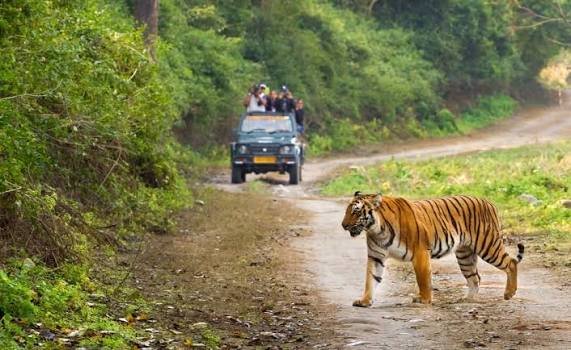
A visit here is completely different from a safari in Ranthambore, Kanha or Bandipur. There are no jeep or Canter safaris. Registered boats and launches are the only way to enter and move through the tourism zone, and an authorised eco-guide accompanies tourist boats. The reserve is open to tourists throughout the year, although October to March is the most comfortable and popular period.
| Particulars | Details |
| Destination | Sundarban National Park / Sundarban Tiger Reserve |
| Where it is located | South 24 Parganas region, West Bengal, in the Ganga-Brahmaputra delta |
| National Park area | About 1,330.12 sq km |
| Tiger Reserve area | 2,584.89 sq km |
| UNESCO status | World Heritage Site since 1987 |
| Safari type | Registered boat or launch only; no jeep safari |
| Typical tourism hours | Daylight cruising, commonly around 7:00 AM to 5:00 PM depending on route and tide |
| Best season | October to March |
| Latest Indian conservation entry planning rate | Around ₹180 per person per day on applicable Sundarban tourism routes |
| Latest foreign visitor planning rate | Around ₹1,000 per person per day |
| Non-AC boat conservation/entry charge | ₹1,000 per day |
| Non-AC launch conservation/entry charge | ₹1,500 per day |
| AC launch/boat conservation/entry charge | ₹3,000 per day |
| Eco-guide | Compulsory with registered tourist boats |
| Recommended stay | 2 nights / 3 days for a fuller experience |
| Nearest major city | Kolkata |
| Nearest railhead | Canning |
Sundarban National Park Timings
Sundarban does not follow the familiar gate-and-road schedule used by most national parks. Tourism is organised around daylight boat movement, tides, permitted waterways and the operating hours of forest camps and watchtowers.
Official route plans commonly use a morning departure at about 7:00 AM and return between 4:00 PM and 5:00 PM. A one-day circuit may include Sajnekhali, Dobanki and Netidhopani, while longer two-day circuits can add Sudhanyakhali, Choragazi and other waterways. Actual timings depend on tide, route approval, boat speed and weather.
The Tiger Reserve’s management plan states that Sundarban remains open for tourists throughout the year. However, October to mid-February is the main tourism period, and the official reserve website recommends October to March. Cyclonic weather, heavy rain, rough water or forest-management requirements can temporarily affect routes.
Sundarban National Park Ticket Cost
There is no single all-inclusive “park ticket” because a Sundarban visit normally combines the individual forest entry charge, watercraft conservation charge, guide fee and the commercial hire cost of the boat or tour package.
The latest traceable West Bengal Forest Department conservation-charge revision introduced higher rates from September 2024. These figures continue to form the basis for current 2026 planning, although the exact amount payable can vary according to the tourism route, camp and type of vessel.
| Charge | Current Planning Rate |
| Indian tourist entry | Around ₹180 per person per day on applicable routes |
| Foreign tourist entry | Around ₹1,000 per person per day |
| Non-AC boat conservation/entry fee | ₹1,000 per day |
| Non-AC launch conservation/entry fee | ₹1,500 per day |
| AC launch / boat conservation/entry fee | ₹3,000 per day |
Some locations and routes can carry separate or higher conservation charges. The final permit amount should therefore be confirmed at the time of booking. The Sundarban Tiger Reserve officially states that permission is issued after payment of entry fees, boat fees, camera fees and other applicable charges.
The figures above are not the commercial boat-hire price. A private operator may charge several thousand rupees per day for the vessel itself, depending on boat size, AC or non-AC category, duration, meals and whether the boat is shared or exclusive. Package-tour prices therefore vary considerably.
Children below five have historically been exempt from conservation entry charges under the state fee framework. Ordinary phone photography is generally treated differently from commercial filming, while drones are prohibited inside the Tiger Reserve.
Boat Safari in Sundarban
The boat safari is the heart of a Sundarban visit. Tourists cruise through tidal rivers and narrower creeks while scanning mudbanks, forest edges and water for wildlife. The viewing experience is slower and quieter than a jeep safari and depends heavily on tide and patience.
Only registered tourist boats can enter the Tiger Reserve. The reserve also requires an eco-guide on tourist boats, and vessels must follow prescribed routes rather than entering creeks freely.
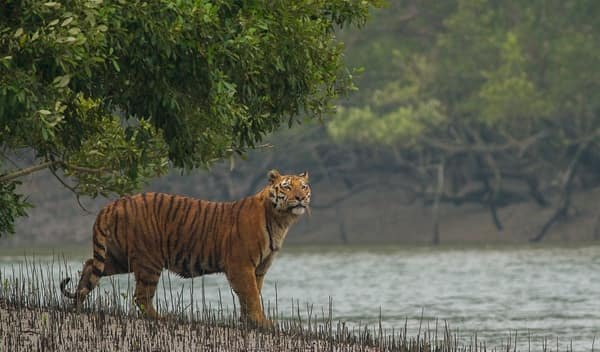
Tiger sightings are possible but should never be expected. Thick mangrove vegetation and tidal waterways make the animals difficult to see. A tiger may appear briefly on a mudbank or swim across a creek, but many rewarding trips produce no tiger sighting at all.
Spotted deer, wild boar, rhesus macaques, estuarine crocodiles, water monitors, kingfishers, raptors and other birds are more realistic sightings. Dolphins may also be seen in suitable channels.
Sajnekhali Watchtower
Sajnekhali is one of the most important tourism stops in the Sundarbans and is often used as an entry and orientation point. The area includes a watchtower, Mangrove Interpretation Centre, crocodile pond and conservation enclosures for the critically endangered northern river terrapin.
The wider Sajnekhali Wildlife Sanctuary is especially important for birdlife, with more than 200 species recorded in the area. White-bellied sea eagles, waders, kingfishers and numerous migratory birds are among the attractions for birdwatchers.
Sudhanyakhali Watchtower
Sudhanyakhali is one of the best-known wildlife-viewing points. Its watchtower overlooks a freshwater pond and open patches where deer, wild boar and occasionally tigers may appear.
A mangrove interpretation garden nearby displays important plant species of the Sundarbans. Because wildlife sightings depend on tide and animal movement, the watchtower is best treated as a patient observation point rather than a guaranteed tiger stop.
Dobanki Canopy Walk
Dobanki offers one of the most memorable non-boat experiences in the Tiger Reserve. Its raised, protected canopy walk runs for roughly 400 metres through mangrove habitat and allows visitors to experience the forest from a different perspective while remaining separated from wildlife.
The journey to Dobanki itself is part of the attraction. Boats pass through rivers and creeks where mudflats can reveal crocodiles, deer, water monitors and birdlife depending on the tide.
Netidhopani and Burirdabri
Netidhopani lies deeper in the tourism zone and is associated with the ruins of an old temple and local folklore linked with the Manasamangal tradition. The forest camp includes a watchtower and interpretation facilities.
Burirdabri, on the eastern side of the Indian Sundarbans near the Bangladesh border, is known for its watchtower, mud walk and protected mangrove cage trail. It offers a different view of the reserve’s tidal landscape and is generally included in longer itineraries rather than short day trips.
Wildlife at Sundarban
The Royal Bengal tiger is the flagship species, but Sundarban wildlife is unusually dependent on both land and water. Tigers here are strong swimmers and regularly cross creeks and channels between mangrove islands.
The Tiger Reserve also supports fishing cats, spotted deer, wild boar, estuarine crocodiles, water monitor lizards and important populations of threatened river terrapins. Gangetic and Irrawaddy dolphins occur in the waterways, while sea turtles use coastal parts of the wider landscape.
The mangroves are equally important as nurseries for fish and shellfish. This makes Sundarban conservation important not only for wildlife but also for fisheries, coastal protection and the livelihoods of communities living around the delta.
How to Reach Sundarban National Park
Kolkata is the main gateway for most visitors. From the city, tourists travel by road and rail towards boat-boarding points such as Godkhali or Dhamakhali before continuing entirely by water.
By Train
Canning is the nearest important railhead. Local trains run from Sealdah to Canning, from where road transport connects travellers with Godkhali and other jetties.
By Road
Buses and private vehicles operate from Kolkata towards Sonakhali, Godkhali and Dhamakhali. Private parking is available near Godkhali Jetty. The final approach into the Tiger Reserve must be by a registered boat or launch.
By Air
Netaji Subhas Chandra Bose International Airport in Kolkata is the nearest major airport. Visitors arriving by air should normally stay in Kolkata or travel onward to a Sundarban gateway depending on the timing of their booked boat.
Best Time to Visit Sundarban
October to March is the best overall period. Temperatures are more pleasant, humidity is lower than in summer and boat cruising is generally more comfortable. Winter is also excellent for birdwatching.
April and May become hot and humid, although wildlife remains active. The monsoon from June to September brings heavy rain, strong tides and dramatic greenery. Sundarban remains open in principle, but rough weather can make tourism less predictable.
Travellers should monitor cyclone warnings carefully. The delta is highly exposed to severe weather, and boat movement may be suspended when conditions become unsafe.
How Much Time Is Needed?
A one-day trip gives only a brief introduction. West Bengal Tourism itself promotes two- and three-day exploration because waterways and attractions are spread over a large area.
Two nights and three days is a better plan for first-time visitors. It allows more time on the river, several watchtowers and a greater variety of creeks without turning the experience into a rushed boat ride.
FAQs
Q. Is a tiger sighting guaranteed in Sundarban?
No. Tigers are difficult to see because dense mangroves and tidal creeks restrict visibility. Seeing one is a matter of luck, even on a multi-day trip.
Q. Why are there no jeep safaris in Sundarban?
The reserve consists of islands, tidal rivers and mangrove creeks rather than a connected road network. Registered boats and launches are therefore the only practical tourism transport inside the reserve.
Q. Can visitors get off the boat anywhere they want?
No. Tourists may disembark only at designated forest camps and tourism points. Walking freely on mangrove islands is not allowed.
Q. Is an eco-guide compulsory?
Yes. The Sundarban Tiger Reserve requires tourist boats entering the reserve to carry an authorised eco-guide, who also helps enforce routes and visitor rules.
Q. Is Sundarban National Park closed during the monsoon?
Unlike many Indian tiger reserves, Sundarban is officially open throughout the year. Severe rain, cyclones, tides or safety conditions can still cause temporary route closures.
Q. Can foreigners visit Sundarban?
Yes. The current official visitor information says foreign tourists can enter through registered tourist boats and should carry valid identity and travel documents. Permit requirements are handled through the authorised booking system.
Q. Is a one-day Sundarban trip worth it?
It can be worthwhile for travellers with limited time, but it covers only a small part of the tourism zone. Two or three days provide a much better sense of the mangrove landscape.
Q. What makes Sundarban different from other tiger reserves?
Its tigers live in a tidal mangrove ecosystem and regularly move between islands by swimming across creeks. Wildlife viewing takes place almost entirely from water, making Sundarban fundamentally different from India’s road-based tiger safaris.